

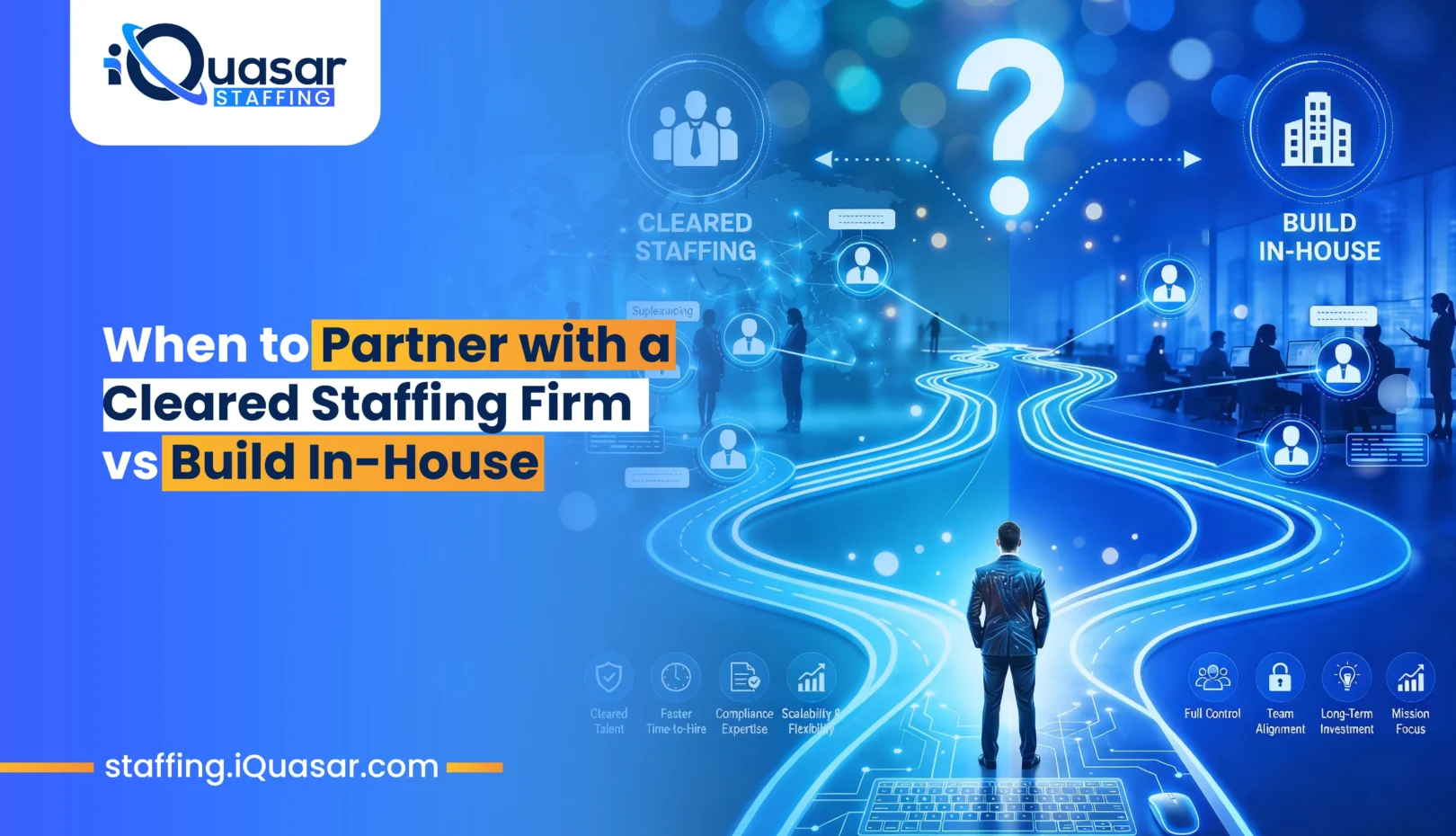
When to Partner with a Cleared Staffing Firm vs Build In-House
Cleared Staffing is increasingly central to government contractors and defense-focused firms that must hire security-cleared professionals quickly, compliantly, and at scale. In 2026, outsourcing increasingly demonstrated its strategic value as a means to access distributed, cleared talent without incurring prohibitive fixed costs. Outsourcing reached 618 billion globally in 2026, a signal that speed, flexibility, and access to specialized skills matter as much as price.
In this blog, we explore how to decide between partnering with a cleared staffing firm and building an internal cleared recruitment capability, with practical criteria, scenarios, and a disciplined decision-making framework.
The Current Challenges in Hiring Security-cleared Professionals
The post-pandemic talent landscape for cleared professionals is characterized by high demand, uneven distribution of talent, and evolving work models. Government contracts still rely on strict regulatory compliance, but talent expectations have shifted toward remote flexibility, competitive compensation, and modern workplace cultures. Cleared hiring now hinges on speed: the longer a candidate review drags, the greater the risk of losing top talent to faster competitors. A recent industry perspective notes that faster decision-making is essential for 2026 success in cleared hiring, particularly as contracting cycles tighten and surge work increases staffing pressure. This reality is compounded by the fact that many programs face bid ceilings and fixed-price constraints, which raise the cost of mis-hires and the value of quickly getting the right clearance-tied skill set aboard. Additionally, security leaders are increasingly weighing in on the insourcing-versus-outsourcing debate to address persistent skill gaps and the need for robust, scalable pipelines.
That landscape underpins the decision framework readers will use below. If speed to hire and access to a broader, pre-vetted pool of cleared talent are the dominant pressures, an outsourced Cleared Staffing approach can deliver immediate value. If you require deep organizational control, a long-term retention strategy, and tight alignment with existing security and onboarding processes, an in-house capability may pay off, but only with a clear ramp plan and cost model.
What a Cleared Staffing Firm provides
A Cleared Staffing firm specializes in delivering cleared talent quickly and compliantly, backed by a scalable onboarding and screening pipeline. The strongest providers bring:
- Access to a broad, vetted talent pool with active clearances and readiness for government programs. This is especially valuable during proposal surges when demand spikes beyond internal capacity.
- Accelerated candidate screening, clearance verification, and onboarding, enabling faster time-to-fill for critical roles.
- Compliance governance, security-clearance administration, and documentation control that aligns with federal requirements and contract-specific obligations.
- Flexible scaling for project-based needs, short-term surges, or ramp-ups during new contract awards, without long-term fixed payroll commitments.
Evidence from supply-chain and staffing analyses in 2026 points to the growing importance of recruitment outsourcing for speed and access to specialized skills. In particular, outsourcing is recognized for enabling rapid response to demand, broader candidate reach, and alignment of talent supply with fluctuating contract requirements. For government-specific needs, firms also leverage external partners to remain nimble during proposal cycles and program ramps, where compliance with clearance requirements and candidate readiness are critical.
For decision-makers evaluating a Cleared Staffing firm, the question isn’t only “can they hire fast?” but “can they maintain ongoing, compliant talent pipelines while integrating with our security posture and remote-work strategy?” The answer often hinges on the provider’s ability to align time-zone coverage, security-cleared onboarding, and the client’s evolving programmatic requirements.
What Building an In-house Cleared Recruitment Team Involves
Creating an internal cleared recruitment capability is a disciplined, long-term investment. It typically involves:
- Hiring specialized recruiters with a deep understanding of security clearances, government contracting, and the nuances of clearance adjudication and renewal.
- Building or procuring a compliant onboarding and clearance-verification workflow, including requisite documentation, background checks, and security training.
- Establishing a mature candidate relationship management (CRM) and applicant tracking system (ATS) tailored to cleared roles, plus integration with internal HR and security offices.
- Developing a budget that absorbs fixed payroll, benefits, facilities, and the cost of ongoing clearance-related compliance (as well as security tools, access controls, and training).
From a total-cost perspective, internal recruitment often carries substantial fixed overhead. Industry analyses in 2026 show that shifting to outsourced or hybrid models can reduce overhead by a meaningful margin. Estimates range from 40% to 60% in some scenarios when you move away from pure fixed-cost payroll toward flexible, on-demand staffing partnerships (the true cost of in-house vs outsourced). However, the payoff of an in-house approach can be strong if you require tight alignment with enterprise security governance, cultural integration with mission teams, and long-term retention of core cleared talent.
Building in-house also demands a readiness to invest in specialized tools and ongoing training. A hybrid approach—where a core in-house team handles strategic planning and sensitive, long-term hires, while an outsourced, cleared staffing partner manages surge hiring and clearance-heavy capacity—often yields faster ROI while preserving control over critical risk management elements (recruitment outsourcing vs. an in-house hiring framework).
Cleared Staffing: Partnering vs. In-House
| Strategy | Pros | Cons |
| Partnering with a Cleared Staffing Firm | • Speed & Scalability: Rapid candidate access and ability to scale quickly for surge work.
• Reduced Fixed Costs: The variable-cost model lowers overhead, payroll, and facility liabilities. • Compliance & Governance: Specialists handle clearance documentation, renewals, and regulatory adherence. |
• Control & Culture: External providers may require strict SLAs to ensure alignment with internal culture and security posture.
• Dependency Risks: Relying on external partners for mission-critical hires can complicate long-term retention without an internal plan. |
| Building In-House | • Organizational Alignment: Embedded teams deliver highly tailored recruitment and foster stronger long-term retention.
• Custom Governance & IP: Complete control over knowledge, tooling, policies, and clearance management integration. |
• Higher Costs & Slow Ramp-up: Requires significant ongoing overhead and takes months to establish effectively.
• Capacity Risks: Internal teams can be quickly overwhelmed by large program surges or unexpected hiring spikes. |
Time-to-hire and scalability considerations directly impact project delivery. Outsourced models typically shorten time-to-fill for cleared roles and provide a buffer during proposal surges, while in-house teams can optimize for long-term stability and program-specific culture, if adequately funded and resourced (time-to-hire considerations; hybrid patterns; hybrid workforce trends).
Cost Comparison: Outsourced vs In-house Cleared Hiring
Cost is a central deliberation, but it isn’t the only determinant. Outsourcing offers variable, demand-driven cost structures and eliminates some overhead tied to office space, equipment, and certain HR processes. In contrast, in-house recruitment incurs fixed payroll and facility costs but may yield long-term savings if the organization maintains a steady need for cleared specialists and vertical-specific retention programs. Industry analyses in 2026 show that operational overhead can drop significantly when shifting to a flexible partner model, with reported reductions of 40%–60% in some contexts (the true cost of in-house vs. outsourced). For many federal programs, the cost-benefit calculus also hinges on the cost-per-hire and the urgency of filling mission-critical roles, where outsourcing can reduce the opportunity cost of stalled projects (cost data and frameworks).
Hybrid models combining core in-house capability with a Cleared Staffing partner for surge periods often deliver the best balance between cost, speed, and control. This aligns with broader market observations that organizations increasingly blend outsourcing with internal teams to maximize value (e.g., recruitment outsourcing vs. an in-house hiring framework).
Scalability for Government Contracts and Proposal Surges
Proposal and program cycles are inherently lumpy. Effective scalability requires a plan that can flex from steady-state hiring to rapid, large-scale talent onboarding. Outsourcing facilitates rapid mobilization during spikes, while in-house teams, supported by a strategic partner, can sustain ongoing recruiting quality across cycles.
It’s good to adopt a blended model to navigate surge dynamics, regulatory demands, and the need for reliable, cleared talent pipelines (hybrid models and scale; policy and staffing trends).
Situations Where Outsourcing Makes More Strategic Sense vs Internal Teams
- When time-to-fill is critical, and you face a clearance backlog or a tight proposal timeline.
- When program demand is volatile, or you must rapidly scale for surge work without committing to fixed payroll.
- When access to an extended cleared talent network is essential to meet stringent clearance requirements across multiple programs.
- When compliance governance and documentation throughput must be standardized and auditable at scale.
Situations Where an Internal Team May be More Effective
- When programs require deep security governance integration, long-term retention of cleared specialists, and tight alignment with a mission-led culture.
- When protracted or strategic hires are central to program success and can be stabilized through internal retention, training, and internal policy ownership.
- When there is a clear cost advantage to maintaining a steady-state pipeline, and the organization has the scale to absorb fixed costs over time.
A pragmatic approach is to use internal recruits for core, ongoing needs and to augment with a Cleared Staffing partner for peaks, special projects, or specialized clearance requirements.
Key Factors for Evaluating Staffing Models
| Key Evaluation Factor | Strategic Considerations |
| Hiring Volume & Contract Cadence | The frequency of your cleared staffing needs and the overall predictability of program demand. |
| Time-to-Fill & Delivery Timelines | Balancing the requirement for rapid talent deployment (speed) against internal oversight (control). |
| Budget Profile | Evaluating the total cost of ownership, specifically comparing fixed internal payroll against variable outsourcing costs. |
| Access & Retention Risk | Determining the intended duration of engagement (short-term contract flexibility vs. full-time, long-term retention). |
| Compliance & Security Governance | Assessing your current onboarding maturity and how easily external or internal models align with your required security posture. |
| Time-Zone & Remote Policies | Ensuring that distributed teams or specific remote-work structures align with your day-to-day operational needs. |
Key Takeaways
- Cleared Staffing decisions must balance speed, cost, and governance in a volatile defense hiring market.
- Cleared staffing firms unlock rapid access to vetted talent and scalable onboarding, complementing internal capabilities during bursts.
- Building in-house cleared recruitment offers deep integration with security governance but requires substantial ramp time and fixed costs.
- A hybrid model often yields the best balance: core internal leadership for governance plus external partners for surge hiring and clearance management.
- Decision criteria should emphasize volume, timelines, budget flexibility, and the maturity of compliance and onboarding processes.
Conclusion
The optimal approach depends on your program mix, timelines, and risk tolerance. For many government contractors facing surge cycles and tight clearance requirements, a thoughtfully designed hybrid model combining a core internal capability with a trusted Cleared Staffing partner delivers speed, scale, and governance. iQuasar Staffing Solutions can help you strengthen your bidding strategy, mitigate post-award schedule risks, and secure top cleared talent faster. Reach out today to build a compliance-ready workforce that sets your next proposal apart.