

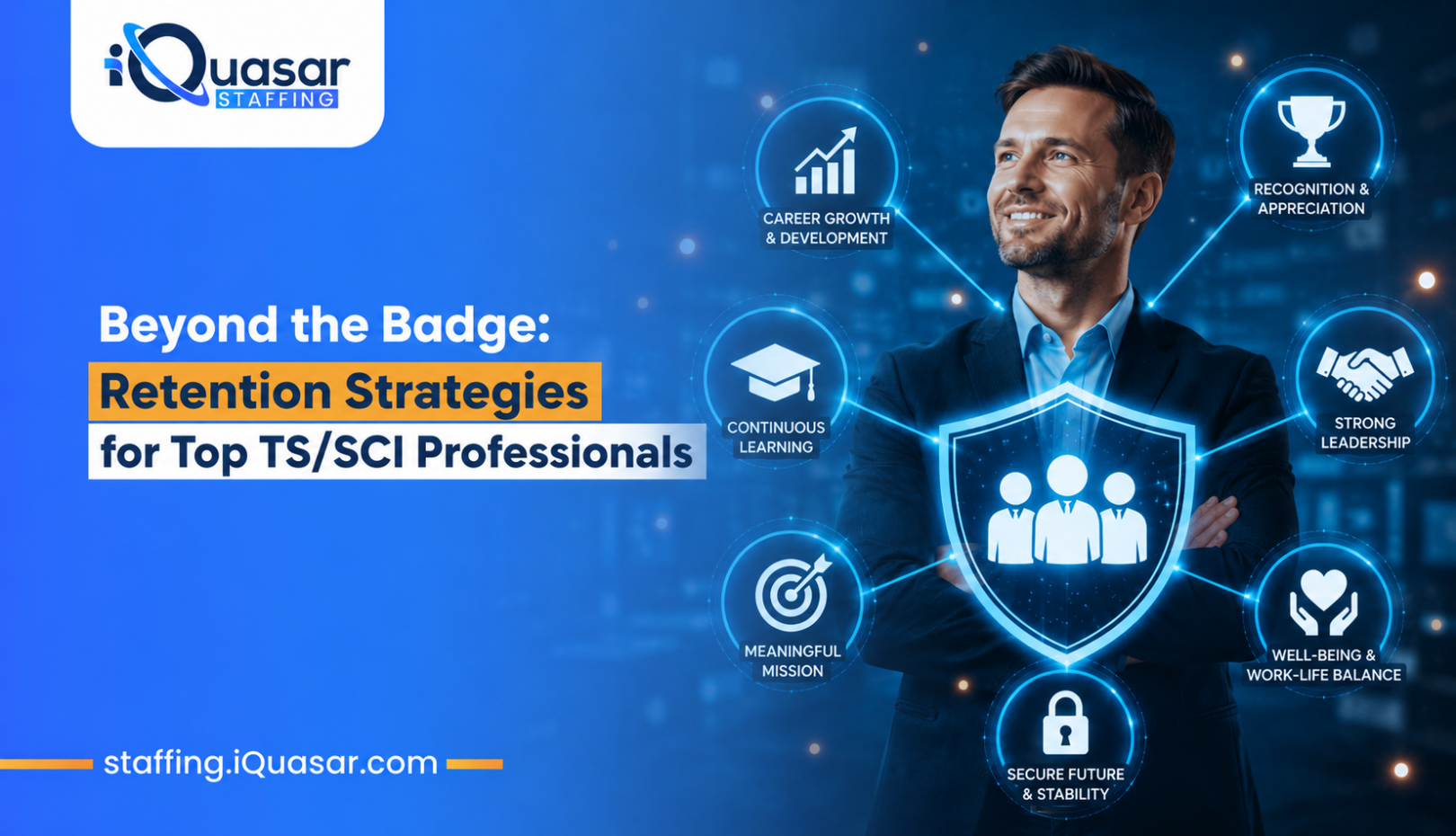
Beyond the Badge: Retention Strategies for Top TS/SCI Professionals
Top 4 Retention Strategies for Top TS/SCI Professionals
In the defense and intelligence sectors, acquiring a professional with an active Top Secret/Sensitive Compartmented Information (TS/SCI) clearance is a major victory. But in a market where unemployment for cleared professionals is essentially zero, acquiring talent is only half the battle. The true test of a successful federal contractor is retention. When a TS/SCI employee resigns, the impact goes far beyond HR. Empty seats jeopardize contract deliverables, risk negative Contractor Performance Assessment Reporting System (CPARS) ratings, and force companies back into a fiercely competitive hiring market.
To keep your best people, you have to move beyond the traditional strategy of simply throwing money at them. Here is how to build a retention strategy that keeps top cleared professionals engaged, loyal, and off the job boards.
The Compensation Trap
The most common mistake contractors make is relying entirely on compensation to retain staff. While competitive pay is a baseline requirement, engaging in a perpetual bidding war is unsustainable. There will always be a competitor willing to offer a slightly higher salary or a larger sign-on bonus to poach your talent.
If your only retention tool is the counteroffer, you have already lost. True retention requires shifting from reactive financial incentives to proactive career engagement.
| Traditional Retention | Modern Retention |
| Reactive counter-offers | Proactive career mapping |
| Standard health benefits | Funded continuous education |
| Focus on job security | Focus on mission impact |
| Rigid onsite requirements | SCIF burnout prevention |
1. Elevate the Mission Over the Task
Highly cleared professionals are often driven by a sense of duty. They undergo rigorous background investigations and invasive polygraphs because they want to contribute to national security. However, it is easy for an engineer or analyst to lose sight of the broader mission when they are bogged down in daily technical tasks.
- Connect the dots: Regularly remind your team how their specific work impacts the agency’s mission.
- Facilitate agency face-time: Whenever possible, allow your contractors to interact directly with government stakeholders. Hearing “thank you” from a federal client validates the importance of their work in a way internal praise cannot.
- Build a culture of purpose: Frame your company not just as a staffing vendor, but as a critical mission partner.
2. Mitigate “SCIF Burnout”
Working in a Sensitive Compartmented Information Facility (SCIF) is physically and psychologically taxing. The inability to see natural light, have a smartphone, or communicate with family during the workday takes a toll. SCIF burnout is a leading cause of turnover among TS/SCI professionals.
While you cannot change the security requirements of a SCIF, you can change how you manage the people inside it:
- Flexible scheduling: If the contract allows, offer alternative work schedules (e.g., 4/10 or 9/80 schedules), so employees get an extra day off to decompress.
- Unclassified days: For roles that allow it, carve out days where employees can work on unclassified professional development, training, or administrative tasks outside the vault.
- Enhanced PTO: Cleared professionals value their time off more than the average corporate employee. Offering generous, flexible Paid Time Off is a massive differentiator.
3. Fund Continuous Upskilling and Certifications
In the technology and intelligence sectors, skills become obsolete quickly. Top-tier professionals fear career stagnation just as much as they fear burnout. If you are not actively investing in their growth, they will find an employer who will.
- Cover compliance costs: Fully fund the training and exam fees for necessary DoD 8570 baseline certifications (like CISSP, Security+, or CEH).
- Sponsor clearances: If an employee holds a Secret clearance, proactively sponsor their Top Secret upgrade. If they hold a TS, sponsor their SCI read-ons. When you invest in a candidate’s clearance, you build deep loyalty.
- Provide dedicated study time: Paying for a certification is good; giving your employee billable time to study for it is exceptional.
4. Conduct “Stay Interviews”
Do not wait for an exit interview to find out why a cleared professional is unhappy. Implement regular “stay interviews” to gauge employee sentiment long before they start taking calls from recruiters.
Ask direct questions:
- Do you feel you have the tools you need to succeed on this contract?
- What is the most frustrating part of your current day-to-day workflow?
- Where do you want your career to be in two years, and how can we get you there?
Addressing a minor frustration in a stay interview can prevent a resignation letter three months later.
Key Takeaways
- Move Past the Bidding War: While competitive baseline pay is required to enter the market, relying strictly on reactive counteroffers is a failing strategy. Competitors can always match or beat numbers; you must compete on culture, mission, and lifestyle.
- Combat Environmental Fatigue: SCIF burnout is an institutional reality driven by isolation and sensory deprivation. Mitigating this through tactical scheduling (such as 9/80 or 4/10 compressed workweeks) and unclassified development days directly targets a primary root cause of cleared turnover.
- Treat Training as a Retention Tool: Top-tier cleared professionals fear stagnation. Funding advanced certifications (e.g., CISSP, CEH) and allocating dedicated, billable study time transforms an operational expense into a powerful loyalty engine.
- Proactive vs. Reactive Management: Transitioning from passive HR practices to active intervention tools—like formal “Stay Interviews”—allows leadership to identify and neutralize friction points before they manifest as resignation letters.
- Protect the Contract Lifecycle: High retention is not just an HR metric; it is a critical defense mechanism for your business assets. Stabilizing your workforce directly protects your CPARS ratings, prevents delivery lapses, and solidifies your reputation as a reliable mission partner.
Conclusion: Securing the Human Capital Infrastructure
In the federal contracting ecosystem, a TS/SCI clearance is frequently treated as a commodity, a box to be checked on a compliance matrix. However, the individuals holding those clearances are highly specialized, mission-driven professionals navigating unique professional stressors. When a company falls into the trap of viewing talent through the narrow lens of labor categories and billing rates, turnover is inevitable.
True retention in the intelligence and defense sectors requires a fundamental paradigm shift. It demands that government contractors transition from reactive employers to proactive stewards of their employees’ careers. By intentionally anchoring your teams to the mission’s ultimate value, actively structuring workflows to counter the psychological toll of the SCIF, and treating continuous education as a mutual investment, you build an organization that is resilient against poaching.
Ultimately, talent retention is the invisible backbone of flawless contract execution. At iQuasar Staffing, our 20-year legacy and 97% customer satisfaction rating are built on this exact understanding. We know that safeguarding national security requires safeguarding the people who execute the work. By treating your cleared professionals as your most critical infrastructure, you do not just protect your headcount, you secure your delivery, your CPARS ratings, and your position as a trusted partner to the federal government.